
Understanding the Brinkerhoff Evaluation Model

The Brinkerhoff Model is one of the more recent methods of evaluating training.
Also known as the Success Case Method (SCM), the framework was introduced in 2003 by Robert Brinkerhoff.
In this blog post, we will explore the Brinkerhoff Evaluation Model in greater detail, discussing its key components, advantages, and limitations. We will also provide examples of how the model has been applied in various contexts, and offer practical tips for those who want to use it to evaluate their own training programmes. Whether you are a programme designer, evaluator, or simply interested in learning more about programme evaluation, this blog post is sure to provide you with valuable insights into this innovative evaluation model.

What is The Brinkerhoff Evaluation Model?
At its core, the model aims to find out how a training or coaching programme works well (or why it’s not working) by focusing on the best and worst learners who have participated in the training. The model does not concern itself with ‘average performance of learners’ like other models or all learners in general. It’s a little niche but it still sees results.
The Brinkerhoff Evaluation Model is useful for assessing the effectiveness of training and coaching programmes.
It offers a nuanced understanding of what works and what doesn’t, and can help programme designers and evaluators to make data-driven decisions about how to improve their programmes. Although it may be a little niche, the Brinkerhoff Model has proven to be a valuable tool for those who are serious about maximising the impact of their training and coaching interventions.
What are the stages of The Brinkerhoff Evaluation Model?
The main goal of SCM is to identify and interview the most and least successful participants of the learning and then compare the differences between them.
To find this out the following five steps are proposed:
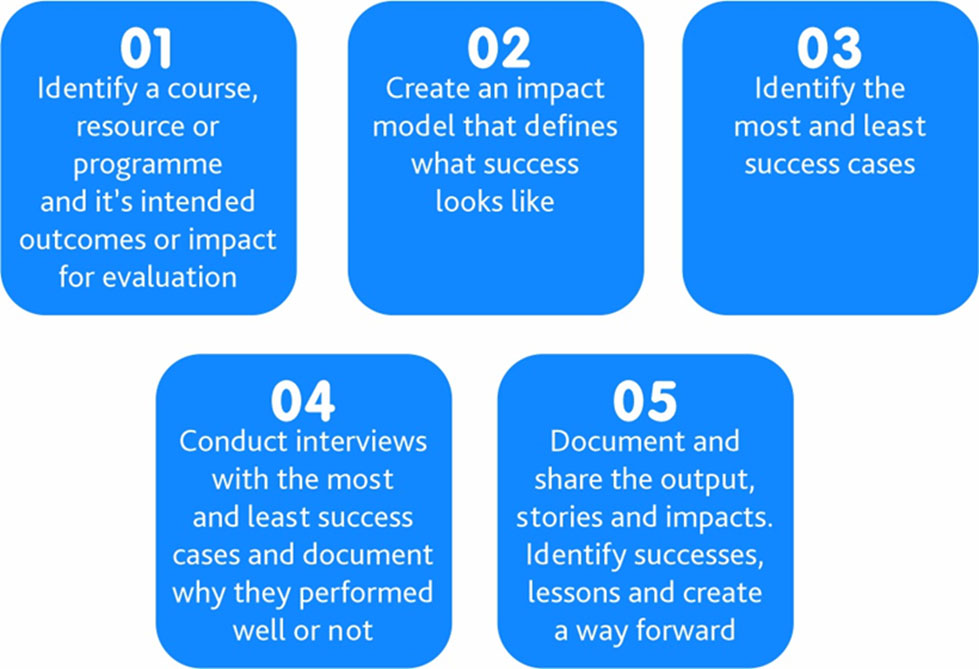
The 5 Steps of The Brinkerhoff Model
- Plan: Determine what programme or course you want to evaluate.
- Define: Make an impact model for the programme/course and define what success should look like for learners taking part in the programme/course.
- Identify: Create a survey/feedback form or any other method to identify the most and least successful learners.For example, who scored the most/least on a test initiated directly after the training. Or who enjoyed the training most/least? Who thought they got the most out of it?
- Document: Conduct interviews off the back of the findings with the most and least successful learners and document why they succeeded/failed or why they enjoyed/didn’t enjoy the training. Bring in supporting evidence.
- Conclude and Recommendations: Communicate your findings with any relevant parties involved – HR, L&D teams – and share the lessons learnt. From here you can make any recommendations for improvement or hold group sessions to improve the training.
By focusing on the best and worst learners, Brinkerhoff’s SCM implies that ‘success’ can easily be identified.
The worst learners can provide evidence of flaws in the training that led them to fail – things that might have been missed or things that need more clarification for example.
Whilst the best learners can provide evidence of what is going well for them to have succeeded – methods/tools used that helped them succeed or any specific resources that cemented the information.
By drawing on the extremes of best and worst, Brinkerhoff suggests that the model can help to identify what is really happening in the training, and how the training can be improved.
One of the key strengths of the Brinkerhoff Model is that it provides a clear and systematic approach for evaluating development projects and allows improvements to be identified early on, which can help to increase the chances of success.
Additionally, the model is flexible and can be adapted to different types of projects and contexts, making it suitable for a wide range of development initiatives.

Brinkerhoff Evaluation Model Case study Example
Here’s an example of how the Brinkerhoff Model could be used to evaluate an emotional intelligence course.
Plan
The emotional intelligence course was aimed at improving the learners’ emotional intelligence skills, with a focus on self-awareness, self-regulation, motivation, empathy, and social skills.
The course was being offered to a group of 10 managers from a variety of departments within an organisation.
The course was being offered because in a recent survey the results illustrated that the managers of the organisation need better communication skills, more self-awareness and that they don’t demonstrate any empathy to their people.
Define
The success of the programme was going to be based on the quality of the design and the delivery of the programme and specific results were to include improvements in employee retention and staff satisfaction.
In addition, post training 360-degree feedback would highlight if the manager’s emotional intelligence areas were improving.
Identify
The defining stage involved assessing the current emotional intelligence skills of the managers.
This was done through assessments, which revealed that most of the managers had a basic understanding of emotional intelligence but needed to improve their ability to apply the concepts in their work environment.
Additionally, the best and worst learners were identified, where best learners were those who had high emotional intelligence and worst learners were those who had low emotional intelligence.
Document
The documentation stage involved interviewing the best and worst learners who provided feedback on the content, materials, and activities for the course.
The course was delivered over a period of two days and was well-received by the two learners. They found the course to be well-organised and relevant to their needs, and they felt they learned a lot from the training even though they were at both ends of the spectrum.
A follow-up survey was conducted to assess the impact of the training on the learner’s emotional intelligence. The survey results indicate that the worst learners have improved their emotional intelligence, particularly in the areas of self-awareness, self-regulation, motivation, empathy, and social skills. Additionally, the company also reports an increase in employee satisfaction of 11% and employee retention of 17%, which can be correlated to the training.
Conclude
The programme was deemed a success with real tangible results and was also designed and delivered in a way that resonated to the learners.
It was recommended that this programme was rolled out to all managers within the company and also an employee version of the programme so everyone within the 120 workforce could benefit from higher levels of emotional intelligence.
Wrapping up
In conclusion, the Brinkerhoff Evaluation Model offers a unique and effective approach to evaluating training and coaching programmes by focusing on the best and worst learners.
By identifying what works and what doesn’t, this model enables programme designers and evaluators to make data-driven decisions to improve their interventions. The systematic, flexible nature of the model makes it suitable for various contexts and development initiatives, as illustrated by our emotional intelligence course case study.
Although it may be considered niche, the Brinkerhoff Model has proven its value in maximising the impact of training and coaching programmes. As a programme designer, evaluator, or simply someone interested in evaluation, exploring the Brinkerhoff Evaluation Model can provide valuable insights into creating more effective and impactful training programmes.