
The Anderson Model: Measuring Organisational Impacts

The Anderson Model is a powerful tool that has gained considerable popularity in the training and development industry over the years. Developed by Jack J. Phillips and Patricia Pulliam Phillips, this model offers a structured approach to evaluating learning programmes and measuring their impact on the overall organisation. It was first introduced in 2006 by the Chartered Institute of Personnel and Development, and since then, it has been widely adopted by many organisations across various industries.
In this blog post, we’ll delve deeper into each stage of The Anderson Model and explore how it can be applied to evaluate the impact of learning programmes in your organisation. Whether you’re a training manager or a learning and development professional, this model can help you measure the success of your training initiatives and make data-driven decisions that drive business growth. So, let’s get started!

What is The Anderson Model?
The Anderson Model is a comprehensive framework for measuring the impact of learning on an organisation’s strategic priorities.
One of the unique aspects of The Anderson Model is that it focuses on evaluating the impact of learning programmes on the entire organisation, rather than just the individual learners who participated in the training. This model takes a holistic approach to learning evaluation, which makes it particularly useful for large organisations that have complex training needs and diverse learning objectives.
Also known as Anderson’s Value of Learning Model, it was developed in response to a study by Brandon Hall that revealed a disconnect between organisational learning solutions and business goals. Many organisations were investing in training programmes without properly aligning them with their long-term strategic priorities, resulting in ineffective learning initiatives and missed opportunities for growth.
To address this issue, the Anderson Model focuses on helping organisations evaluate their learning solutions in light of their strategic goals. By following the Anderson Model, organisations can ensure that their learning initiatives are closely aligned with their long-term business goals and are delivering real value to the organisation. This can help to drive innovation, increase productivity, and improve overall business performance over time.
What are the stages of The Anderson Model?
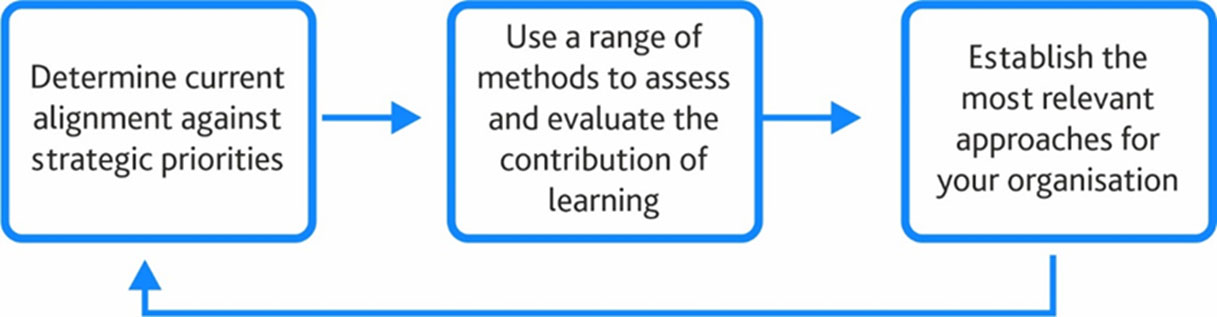
The Anderson Model is composed of three distinct stages that help organisations measure the impact of their training programs.
Each stage plays a crucial role in evaluating the effectiveness of learning initiatives and driving meaningful results. Let’s explore each stage in more detail.
Stage 1 of The Anderson Model: Determine current training against strategic organisation goals
To start with, the model aims to determine the current alignment of the learning that you offer against the strategic priorities for your organisation. To review what training is currently being conducted and whether it’s aligned with the overall goals of the business.
So, for example, your strategic priorities for your organisation might include:
- Aggressive sales growth of 25%.
- Increased production of 15% (to be aligned with the point above. Supply and demand).
- To reach a new market within Europe.
- Reduce staff of attrition of 18% down to less than 10%.
The question is then this:
“To what extent are your learning and development solutions supporting these priorities and are they focused on them?”
Is everything aligned and joined up?
If there’s not a sales development programme in place or some kind of sales academy where your salespeople continually upskill and improve then how will your organisation reach, it’s aggressive sales growth target of 25%?
Stage 2 of The Anderson Model: Assess and evaluate the contribution of The Learning
Within this stage it evaluates the contribution and role that learning, and development has on your organisation.
The model is not prescriptive when it comes to this, but it does identify hour key areas that should be evaluated and measured:
Learning and Development function measurements
- How effective is your L&D function?
- How effective and efficient are your L&D team members?
- How effective are the trainers and any sub-contractors or external suppliers that you use?
Return on expectation measurements
- Do your learning and development solutions deliver what they were intended to deliver? i.e. improved sales by 10%, better team morale?
- Have the expectations of your solutions been met? Did they achieve what they set out to achieve?
ROI measurements
- Cost v Benefit analysis. i.e., sales training costs £120,000 but the uplift in sales was £1.2 million.
Benchmarking measurements
- How does your solutions compare to external factors, competitors, and standards?
Stage 3 of The Anderson Model: Establish the most relevant approaches
The final stage is to develop a plan of action that suits your organisation.
There are many factors to consider when determining this and how your organisation positions learning and development.
For example, I’ve come across thousands of organisations who believe wholeheartedly that they are doing the right thing by offering learning solutions whereas thousands of others view learning as a cost to the business.
Go figure!
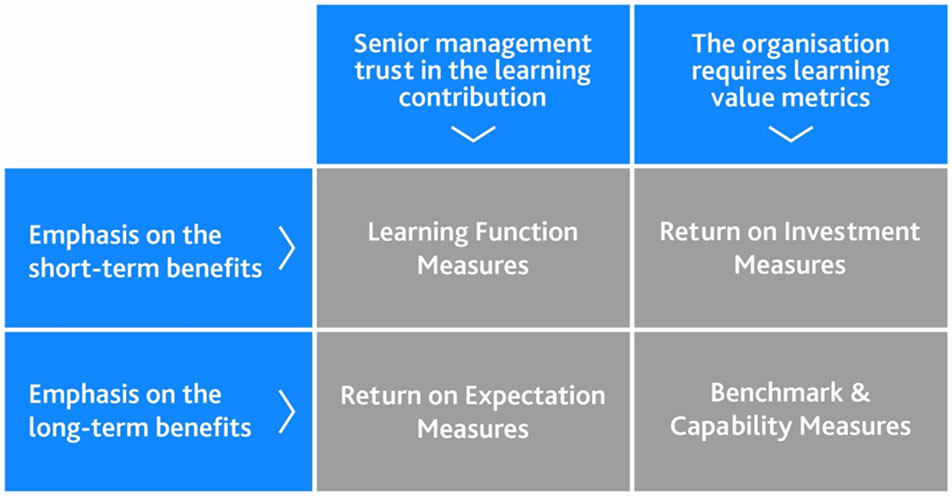
The emphasis and importance that you place on metrics and the type of metrics will determine what approaches you use. It’s a unique and personal thing to your organisation.
For example, some organisations want a quick return. Others, play the long game.
And it’s whether your organisation is focused on the short- or long-term benefits of learning and development and whether your stakeholders and organisation as a whole values learning, ultimately determines what metrics you will want use.
This can be summarised in the table below:
Conclusion
The Anderson Model provides a comprehensive and effective approach to measuring the impact of learning initiatives. By using this model, organisations can identify areas of improvement, measure progress, and align their learning initiatives with their long-term goals. This results in increased productivity, improved business performance, and ultimately, greater success.
Moreover, the Anderson Model enables organisations to track the return on investment (ROI) of their learning initiatives, providing valuable insights that can help in decision-making and resource allocation. It empowers organisations to continuously improve their learning programs, ensuring they stay relevant and effective in a rapidly changing business environment.
In conclusion, the Anderson Model is a valuable tool for organisations that want to ensure their learning initiatives are aligned with their strategic priorities and deliver real value to the business. By adopting this model, organisations can drive innovation, improve productivity, and achieve their long-term goals.